
What Are Crystal Nail Files Made Of? Materials, Benefits, and Safety

If you have seen a sleek, transparent nail file labeled “crystal,” you may wonder whether it is actually made from crystal, glass, or some special mineral.
So, what are crystal nail files made of? Most high-quality crystal nail files are made from hardened or tempered glass. Many premium versions use Czech or Bohemian glass. Instead of having sandpaper-like grit glued onto the surface, quality crystal files usually get their filing texture by permanently etching tiny abrasive patterns directly into the glass.
That construction is what gives a good crystal nail file its smooth feel, reusable surface, and long lifespan.
However, the word crystal can be confusing. It does not necessarily mean the file is carved from quartz, gemstones, or decorative lead crystal.
Below, we will break down exactly what crystal nail files are made from, how their surfaces are created, how they compare with ordinary glass and emery boards, and what to look for when choosing one for your nails.
Quick Answer
Crystal nail files are usually made from hardened or tempered glass with a finely etched abrasive surface. Premium versions are often made from Czech or Bohemian glass. The word “crystal” is mostly used to describe this type of high-quality glass nail file—it generally does not mean the tool is made from natural quartz crystal or gemstones.
What Exactly Is a Crystal Nail File?
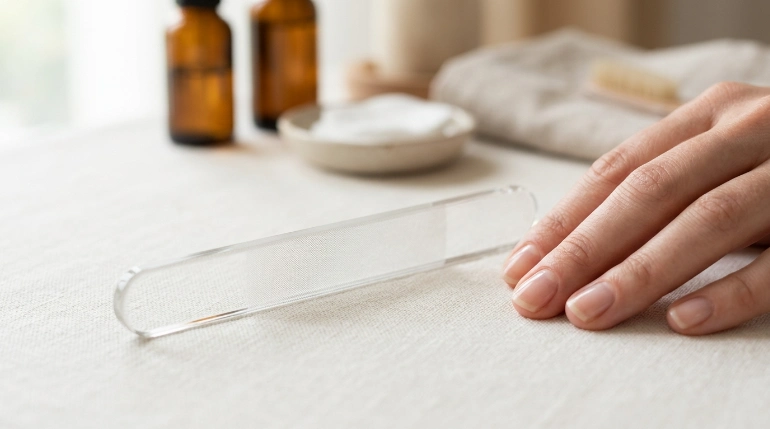
A crystal nail file is a reusable manicure tool designed to shorten, shape, and smooth the free edge of your nail.
The free edge is simply the part of the nail that extends beyond your fingertip.
Unlike a traditional emery board, which usually has abrasive particles attached to a board or flexible core, a high-quality crystal file uses the glass itself as the filing surface.
Manufacturers create microscopic peaks and valleys on the glass so the surface can gradually remove tiny amounts of nail material.
GERMANIKURE, for example, describes its crystal nail files as thick tempered Bohemian glass with a permanently etched filing surface.
That distinction matters because an etched surface does not depend on loose grit glued to a disposable backing.
What Are Crystal Nail Files Made Of?
The simplest answer is glass—but specially processed glass.
1. Tempered or Hardened Glass
Quality crystal nail files are commonly made from tempered glass.
Tempering is a strengthening process that makes the finished glass more resistant to normal everyday stress than ordinary untreated glass.
That does not make a crystal nail file unbreakable. It is still glass, so dropping it onto tile, concrete, or another hard surface can chip or crack it.
However, tempering makes it much more practical as a reusable manicure tool.
Some premium brands specifically use thick tempered Bohemian or Czech glass in their files.
2. An Etched Glass Filing Surface
The second important part is the texture.
A good crystal nail file usually does not rely on a layer of sand or abrasive particles stuck onto its surface.
Instead, the glass itself is etched to create the rough microscopic texture needed for filing.
One manufacturer describes this process as chemically etching the glass to produce a consistent abrasive surface.
When you move the file along your nail edge, those microscopic textured areas remove very small amounts of keratin.
Your visible nail plate is largely made of layers of keratin protein, so filing gradually changes the length and shape rather than cutting the nail in one motion.
3. Decorative Finishes May Be Added
Crystal files may also have:
- Colored handles
- Painted sections
- Printed designs
- Rhinestones or decorative accents
- Frosted areas
- Protective sleeves or cases
These features affect appearance and handling but are not normally what creates the actual filing action.
The working part is the textured glass surface.
Are Crystal Nail Files Actually Made From Crystal?
Usually, not in the gemstone sense.
You should not assume that a product called a “crystal nail file” is made from quartz crystal, rock crystal, or another naturally occurring gemstone.
In nail-care marketing, crystal file and crystal glass file are commonly used for premium glass nail files, especially those made with tempered and etched glass.
That is why packaging can be confusing.
If you want to know what you are actually buying, look at the product description rather than relying only on the word crystal.
Useful descriptions include:
- Tempered glass
- Hardened glass
- Czech glass
- Bohemian glass
- Etched glass surface
- Chemically etched
- Permanent filing surface
Also remember that exact glass formulations and manufacturing methods can vary between brands. If a manufacturer does not disclose those details, you should not assume that every crystal file has exactly the same composition.
Crystal Nail File vs. Glass Nail File: Is There a Difference?
In everyday beauty shopping, the terms often overlap.
A high-quality crystal nail file is generally a type of glass nail file.
But not every product marketed as a glass file necessarily has the same construction or quality.
The more useful question is how the filing surface is made.
A quality etched file has its texture formed directly in the glass. Some inexpensive alternatives may rely more heavily on surface coatings that can become smoother as they wear.
If you are comparing options, NailPrime’s guide to the best crystal glass nail files explains what to look for in size, surface texture, durability, and handling.
How Crystal Nail Files Are Made
Exact production processes vary, but a quality glass nail file generally goes through several basic stages.
Step 1: Glass Is Formed and Cut
A sheet or blank of suitable glass is produced and cut into the long, narrow shape of a nail file.
Different manufacturers offer different:
- Lengths
- Thicknesses
- Tip shapes
- Handle designs
Travel files tend to be shorter, while full-size files provide more surface area for everyday manicures.
Step 2: The Glass Is Strengthened
The glass may be tempered or hardened to make it more resistant to everyday handling.
This is particularly important because a thin piece of ordinary glass would be impractical inside a manicure kit.
Step 3: The Surface Is Etched
This is the step that transforms a smooth glass blank into a working nail file.
The surface is treated to create microscopic abrasive texture.
GERMANIKURE states that its crystal glass files are chemically etched, producing the texture used for shaping the nail.
Step 4: Edges Are Finished
The outer edges and tip should be properly finished so they do not feel dangerously sharp in your hand.
A poorly finished glass tool should not be used around your fingers or cuticles.
Step 5: Decorative and Protective Elements Are Added
Depending on the design, manufacturers may add colors, patterns, branding, handles, or protective cases.
A case is particularly useful because even tempered glass can be damaged by a hard impact.
Crystal vs. Emery vs. Ceramic vs. Metal Nail Files
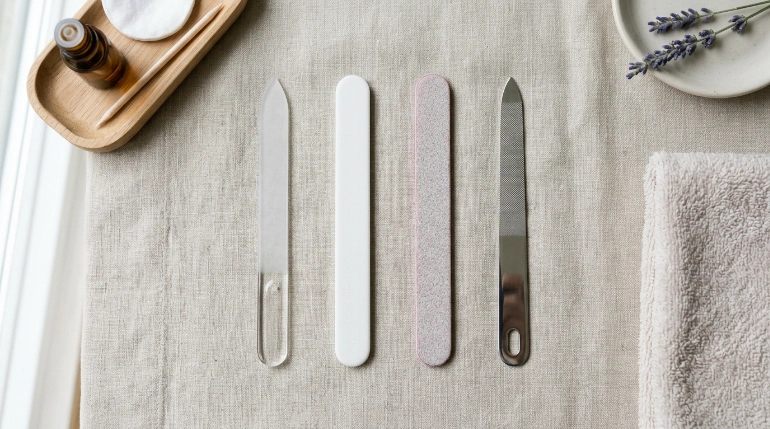
The material affects how a nail file feels, how long it lasts, and how easy it is to clean.
| Nail File Type | Typical Construction | Best Use | Main Advantage | Main Limitation |
|---|---|---|---|---|
| Crystal/glass | Tempered or hardened etched glass | Natural nail shaping and smoothing | Reusable and precise | Can break if dropped |
| Ceramic | Textured ceramic material | Controlled natural-nail shaping | Durable and reusable | Coarse versions may feel aggressive |
| Emery board | Abrasive material attached to board/core | Everyday shaping | Cheap and widely available | Surface wears down |
| Metal | Textured metal | Sturdy or thicker nails | Extremely durable | May feel aggressive on thin nails |
| Buffer | Fine abrasive on foam/block | Nail-surface smoothing | Flexible and gentle when used correctly | Over-buffing can thin nails |
If you want a broader comparison, NailPrime’s guide to different nail file materials covers glass, ceramic, emery, metal, and other common choices.
Why Does an Etched Glass Surface Matter?
One of the biggest advantages of a quality crystal file is that the abrasive texture is part of the glass rather than a disposable layer sitting on top.
That means the filing surface can remain usable for a long time if you keep it clean and avoid physical damage.
Nail dust can collect inside the microscopic texture, however. When that happens, the file may seem smoother or less effective even though the etched surface itself is still present. Manufacturer care instructions for etched glass files commonly recommend cleaning away accumulated debris with water and mild soap.
Always follow the specific cleaning directions supplied with your file, especially before using alcohol, disinfectants, very hot water, or professional sterilization equipment.
Are Crystal Nail Files Gentle on Natural Nails?
They can be.
A fine, evenly textured glass file gives you a lot of control because it removes a small amount of nail with each stroke.
That can be useful when you are:
- Smoothing a snag
- Maintaining an oval or almond shape
- Rounding square corners
- Correcting slightly uneven lengths
- Refining the nail after clipping
The American Academy of Dermatology’s nail-trimming guidance recommends using a nail file to slightly round the corners of fingernails after trimming.
However, no nail file is damage-proof.
Even a premium crystal file can weaken a nail if you use too much pressure, repeatedly file the same area, or aggressively thin the top surface of the natural nail.
What About Thin or Peeling Nails?
If your nails are already thin, peeling, or flexible, use very light pressure.
You do not need to force the file against the edge.
For fragile nails:
- Make small corrections rather than major shape changes.
- Stop if the nail starts bending while you file.
- Avoid aggressively filing the top of the nail plate.
- Keep the nail and surrounding skin moisturized.
- Do not use filing to hide unexplained nail damage.
NailPrime’s guide to healthy natural nail growth can help if your bigger goal is maintaining stronger natural nails.
How to Use a Crystal Nail File Safely
Crystal nail files are beginner-friendly, but technique still matters.
1. Check the File First
Inspect the file before using it.
Do not use it if you notice:
- A cracked body
- A chipped tip
- Sharp broken edges
- Major surface damage
2. Start With a Visible Nail Edge
Make sure you can clearly see the shape and condition of the free edge.
If your nail is painful, bleeding, swollen, or visibly infected, filing should not be your first priority.
3. Use Light Pressure
Place the textured section against the free edge and let the surface do the work.
There should be no need to push aggressively.
4. Shape Gradually
Check your nail every few strokes.
Taking off another millimeter is easy. Putting length back is impossible.
5. Smooth Only What Needs Smoothing
Once the edge feels even and no longer catches, stop.
More filing is not automatically better filing.
Expert Tip: If you have to press hard for your crystal file to work, clean the surface first. Nail dust may be filling its microscopic texture. If cleaning does not restore performance, inspect the file for wear or damage before applying more pressure.
How Do You Clean a Crystal Nail File?
One reason people like glass files is that many are washable.
For a personal at-home file, the manufacturer’s directions may allow a simple routine such as:
- Rinse away loose nail dust.
- Wash gently with mild soap and water.
- Remove residue with a soft brush if permitted.
- Rinse thoroughly.
- Let the file dry completely.
- Return it to its protective case.
Do not assume every decorated or coated file can handle every disinfectant.
If the product has painted details, adhesives, embellishments, or a special handle, check its care instructions.
Hygiene matters with all manicure tools. The American Academy of Dermatology advises against sharing nail-grooming tools and recommends proper cleaning or disinfection to reduce the risk of fungal infection.
Should You Share a Crystal Nail File?
For home use, keeping your own nail tools personal is the simplest approach.
Do not casually share a file between people, especially if someone has:
- Nail fungus
- Broken skin
- Bleeding
- Inflamed cuticles
- Pus or drainage
- An unexplained nail condition
A washable material does not mean you can ignore proper hygiene.
At a salon, professional cleaning and disinfection practices are especially important because tools are used around many clients. The AAD’s manicure and pedicure safety guidance recommends paying attention to salon sanitation practices.
Are Crystal Nail Files Worth the Cost?
Crystal files usually cost more upfront than basic disposable emery boards.
Whether that extra cost makes sense depends on how often you file your nails.
A crystal file may be worth it if you:
- Maintain natural nails regularly
- Want a reusable manicure tool
- Prefer a fine, controlled filing feel
- Are tired of throwing away worn emery boards
- Want a tool that can often be washed
- Will store the file carefully
An inexpensive emery board may be enough if you:
- Rarely file your nails
- Need several different grit levels
- Regularly work on thick artificial enhancements
- Frequently lose or damage manicure tools
- Prefer disposable files
A more expensive file is not automatically safer.
Construction, surface quality, appropriate abrasiveness, and your technique matter more than luxury packaging.
Crystal Nail Files and Acrylic or Gel Nails
Crystal files are especially popular for natural-nail maintenance.
Using one on artificial enhancements is more complicated.
Thick acrylic, hard gel, or other enhancement products can require much faster material removal than a fine natural-nail file is designed to provide.
Trying to grind away a large amount of enhancement with a fine crystal file can be slow. Using excessive pressure to compensate can also reduce your control.
And when you get close to your natural nail, aggressive filing can thin the nail plate.
The AAD notes in its guidance on artificial nails that repeated enhancement services and removal can leave natural nails thinner, brittle, or damaged.
For major acrylic or hard-gel removal, professional help may be the safer choice if you do not know where the enhancement ends and your natural nail begins.
Common Mistakes to Avoid
Even though crystal files are simple tools, these habits can cause trouble:
- Assuming “crystal” means gemstone. Most crystal nail files are specialized glass files.
- Buying by appearance alone. Look for actual material and surface information.
- Pressing too hard. A properly functioning fine file should work with controlled pressure.
- Over-filing thin nails. More filing can make already fragile edges weaker.
- Filing aggressively across the top surface. A shaping file is primarily intended for the free edge.
- Using a chipped glass file. Replace damaged glass rather than risking a rough or sharp edge.
- Throwing it loose into a purse. Use a sleeve or protective case.
- Ignoring hygiene. Clean the file according to its manufacturer’s instructions.
- Sharing personal manicure tools unnecessarily. Keeping your own file reduces cross-contamination concerns.
- Trying to file away nail disease. Discoloration, thickening, separation, or infection is not simply a surface problem.
When to See a Nail Technician or Dermatologist
A nail technician can be helpful when your concern is cosmetic.
For example, consider professional nail help when you need:
- Major reshaping of acrylic nails
- Hard-gel maintenance
- Enhancement balancing
- Professional product removal
- Help correcting an uneven manicure
A dermatologist or other healthcare professional is more appropriate when your nail or surrounding skin looks medically abnormal.
Watch for:
- Persistent redness
- Swelling
- Warmth
- Pus or drainage
- Ongoing pain
- Nail separation
- Significant unexplained thickening
- Crumbling nails
- New or unexplained discoloration
- A dark streak that has not been evaluated
- Bleeding around the nail
- Sudden major changes in nail shape
The Mayo Clinic’s healthy fingernail guidance recommends paying attention to unusual changes and avoiding habits that damage the nail or surrounding tissue.
Do not try to file away a suspicious nail change. A nail file is a grooming tool, not a way to diagnose or treat infection, disease, or injury.
FAQs
What are crystal nail files made of?
Most quality crystal nail files are made from hardened or tempered glass. Premium versions may use Czech or Bohemian glass with an abrasive texture etched directly into the surface.
Are crystal nail files really crystal?
Usually not in the sense of natural quartz or gemstones. “Crystal nail file” is commonly a beauty-industry term for a quality glass nail file, particularly one made from etched, tempered glass.
Are crystal nail files the same as glass nail files?
The terms frequently overlap. Most crystal nail files are glass files, but construction quality can vary. Look for tempered or hardened glass and an etched filing surface rather than relying on the product name alone.
Why do crystal nail files feel different from emery boards?
A crystal file can have a fine abrasive texture formed directly in the glass. An emery board typically relies on abrasive material attached to a flexible or rigid backing, creating a different filing sensation.
Do crystal nail files wear out?
A permanently etched quality glass surface can remain effective for a long time, but nail debris may clog its microscopic texture. Cleaning can restore performance in many cases. Replace the file if it becomes chipped, cracked, permanently damaged, or no longer performs properly.
Can I wash a crystal nail file?
Many quality glass files are washable, but always check the manufacturer’s instructions. Mild soap and water may be enough for routine personal cleaning when permitted by the manufacturer.
Are crystal nail files safe for weak nails?
They can be a good option for gentle shaping when used with very light pressure. However, a crystal file cannot repair an unhealthy nail. If your nails are suddenly peeling, painful, discolored, thickened, or separating, investigate the cause rather than simply filing more.
Conclusion
So, what are crystal nail files made of?
In most cases, a quality crystal nail file is made from hardened or tempered glass with a finely etched abrasive surface. Premium products often use Czech or Bohemian glass, while the term crystal generally refers to this style of glass file rather than a natural gemstone.
The etched construction is a major reason these tools can feel smooth, precise, washable, and reusable.
But material alone does not guarantee healthy nails.
Choose a well-made file with a consistent surface, inspect it for chips, use light pressure, keep it clean, and protect it from drops. Most importantly, use your crystal file for normal grooming—not as a way to remove suspicious discoloration, infection, injury, or other nail problems.
For routine natural-nail maintenance, a quality crystal nail file can be a practical long-term upgrade from disposable files when you choose carefully and use it gently.

